Battery Polarisation
Polarisation describes the operational
This deviation arises due to several factors, including reaction kinetics, ionic transport limitations, and internal resistances. The induced field strength increases with cell resistance.
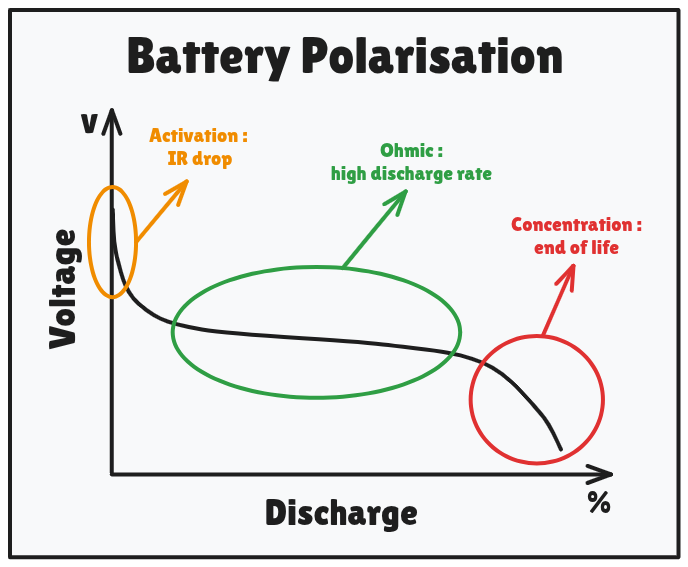
Activation polarisation
Due to the electrochemical reactions activation energy at the electrode surface, it is determined notably by kinetics of electron transfer with the electrolyte. It dominates at low current densities and at the beginning of a battery’s operation, for example during initial intercalation and de-intercalation for Li-ion batteries.
Mitigation strategies include increasing electrode catalytic activity, increasing active specific surface area and/or electrolyte concentration (therefore strengthening the electronic double layer), raising operating temps and using catalysts.
Ohmic polarisation
Ohmic polarisation results from innate internal cell resistance (from the electrodes, separator/membrane and electrolyte) hindering current. Electrolytes and separators with high ionic conductivity, and low-resistance electrodes will mitigate this effect.
Concentration polarisation
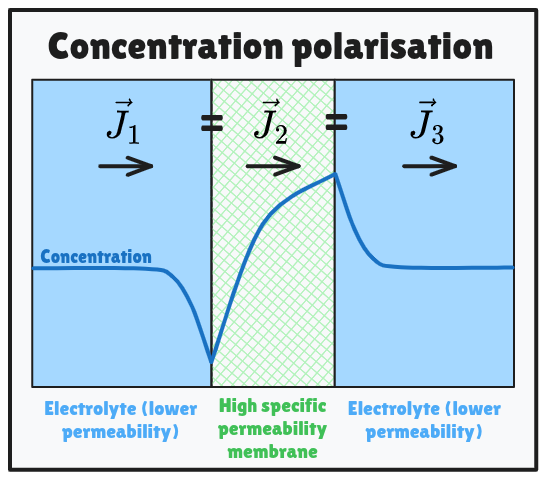
Once a cell reaches a critical SOC, further charging becomes energetically costly, resulting in a "concentration overpotential". At high current densities, ion transport limitations lead to important current gradients, intensifying polarisation. This in turn increases osmotic pressure acting against the charging ionic current. Raising temperatures and concentrations mitigates these transport limits, along with increasing active electrode surface area.
Sources : https://www.musabbesbadem.com/2024/03/03/understanding-polarizations-in-battery-kinetics/