Metallic Organic Framework (MOF) applications for ZBRBs
MOF UiO-66/-67 was used in a composite membrane, and its 6-8 Å windows effectively block
For ZnBr₂ flowless batteries, amidated and sulfonated UiO-66 supported on Nafion (NF/U-AS) was developed. Bromine crossover was suppressed via chemical binding of Br₂/
Source : 10.1007/s40820-026-02068-0
Zinc coordination polymer glass MOF
Amorphous glass (
The usual way they are prepared is:
- Make a Zn-based coordination polymer precursor whose framework can survive heating long enough to melt or soften.
- Ensure its melting temperature is below its decomposition temperature.
- Heat above
to form a viscous liquid or soft molten phase. - Quench, cast, or hot-press that melt to trap the disordered structure as a glass.
This is the classic melt-quench route used across Coordination Polymer (CP)/MOF glasses. Researchers then verify glass formation with DSC/TGA for
MOF suppression of HER in iron flow batteries
Iron flow batteries
- Parasitic hydrogen evolution (HER) elevates interfacial pH, triggering irreversible
precipitation that depletes electrolyte and induces flow channel occlusion (obstruction) - HER :
so pH increases - Tip effect promotes preferential vertical Fe growth over planar deposition
- Areal Fe loading capacity : the amount of iron that can be deposed per surface area
Solutions
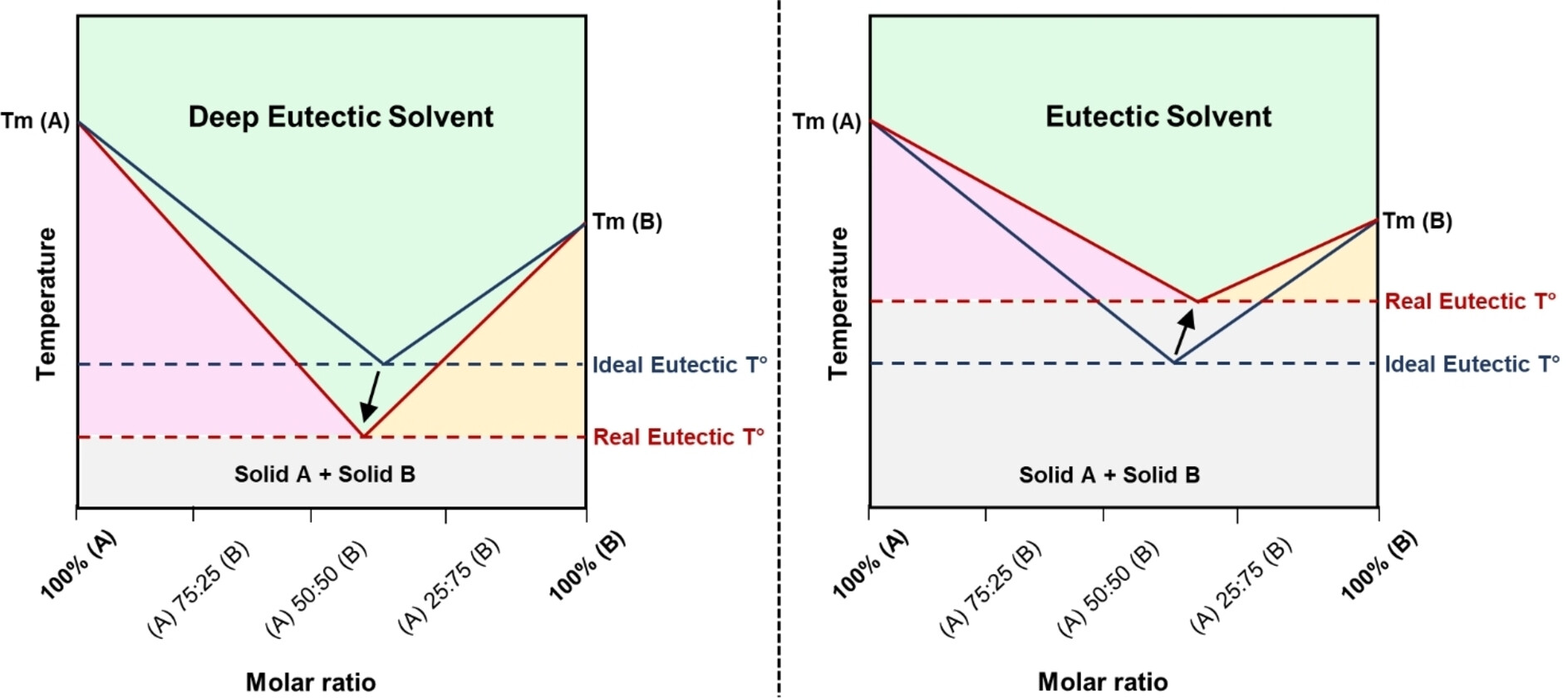
- Deep eutectic solvents modify solvatation structure and prevent hydrolysis
-citric acid complexes improve deposition morphology - DMSO cosolvent reorganises the
solvation sheath, leading to enhanced deposition control and reduced HER
Overarching issue
- Poor electrochemical activity and low hydrogen evolution energy barrier of traditional carbon electrodes (e.g., carbon felt, carbon cloth, carbon paper) => competitive disadvantage between Fe deposition and hydrogen evolution => electrode catalysts are used
- Early transition metals (Ti, Zr, W, and Sc) exhibit weak hydrogen atom binding abilities, thereby limiting HER activity (WO3 nano-particle modified graphite electrodes demonstrate > 95 % coulombic efficiency). Their incorporation in MOFs could allow for high surface accessibility, abundant unsaturated coordination sites, and optimised charge transport pathways.
- ATMP -> aminotris(methylenephosphonic acid) is a colourless phosphonic acid solid with chemical formula
. Its conjugate bases, such as , have chelating properties.
O=P(O)(O)CN(CP(=O)(O)O)CP(=O)(O)O
Protocol
- Materials : Zirconium chloride, Polytetrafluoroethylene (PTFE), Nitrilotrimethylene Triphosphoric Acid solution (ATMP, 50 % in water), Ndimethylformamide solution (DMF) and N-Methyl pyrrolidone solution (NMP), Ferrous chloride and Potassium chloride, Carbon felt (4.0 mm thickness) and graphite sheet
- Synthesis : 2 g of ZrCl4 was dissolved in 200 mL of DMF, then dropwise addition of 5.56 mL of ATMP. Magnetic stirring at 80°C for 12 h. Centrifuge the resulting precipitate, and wash three times with deionised water, then dry
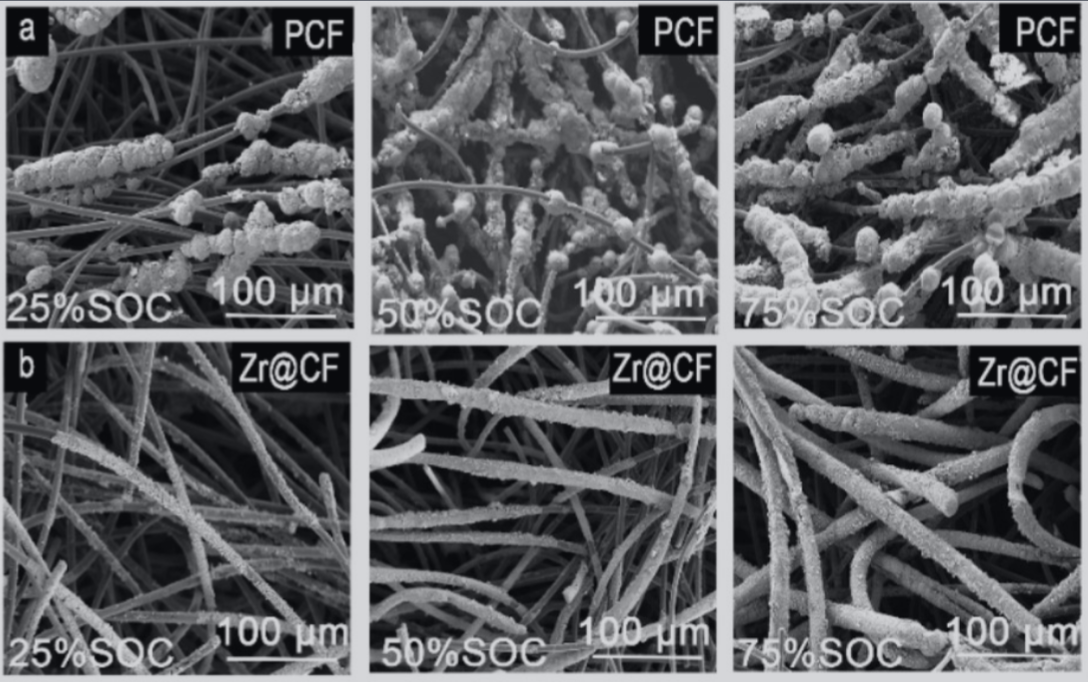
- PCF = Porous carbon foam
- Zr@CF = zirconium on carbon felt
- Zr@GS = zirconium on graphite sheet
- The Barrett-Emmett-Teller (BET) surface area was determined from nitrogen adsorption/desorption isotherms using a Quanta chrome volumetric analyser
Characterisation
- Material : SEM, TEM, XPS for surface chemical state (binding energy) (quantitative composition analysis), four probe resistivity measurement, AFM
- Electrochemical : LSV, CV, EIS, CA (CF is working electrode, along with an iron sheet CE and SCE reference)
- H2 evolution : LSV test from 0 to 1.8 V (vs. SCE) in 3 M KCl solution at a scanning rate of 10 mV/s
- Fe/Fe2+ redox R° : CV at scan rate of 20 mV/s from 0 to 1.5 V (vs. SCE)
- EIS : voltage of 1.0 V (vs. SCE) at the frequency range from 10⁵ to 10⁻¹ Hz with an amplitude of 5 mV
- CA : potential conducted by potentiation current transients from 1 to 1.15 V (vs SCE) to analyze current transients
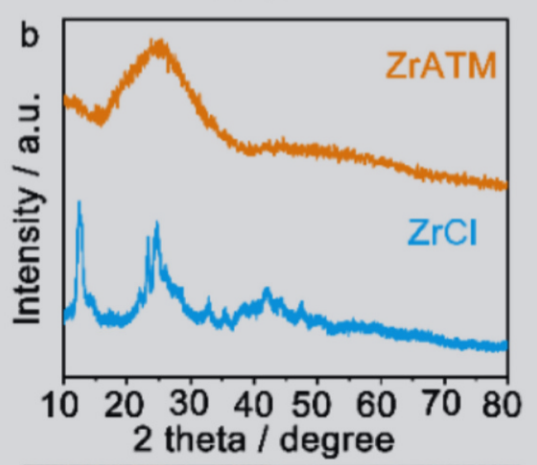
DRX
- broad diffraction peak centered, accompanied by a substantial diminishing of the Bragg diffraction peaks of the precursor confirm that ZrATMP loses the long-range crystalline ordering, exhibiting an amorphous-like nature
BET Analysis
- type II isotherm, typical of mesoporous materials. The material exhibits a predominant micropore size of averaging 2.3 nm and a specific surface area of 80.02 m²/g
LSV
- The LSV curves in 3 M KCl solution (Fig. 2b) show that the potential of hydrogen evolution reaction (HER) shifts to a more negative value with a higher ZrATMP loading, suggesting a suppressed HER at high catalyst loadings
SEM at different SOC
Simulation
- They also calculated Fe2+ concentration distribution by the finite element simulation for PCF and Zr@CF3
- The Gibbs' free energy of the water dissociation (
) is 2.59 eV on ZrATMP, which is 0.32 eV larger than that on PCF. This elevated energy barrier suppresses interfacial hydrogen adsorption and HER kinetics.
XPS
- as the minimized d-p band center gap in ZrATMP (Fig. 4c) reduces bonding-antibonding orbital separation, thereby enhancing redox reaction kinetics
Long-term cycling reveals that the all‐iron flow cell with Zr@CF3 electrodes sustains 200-cycle operation with an average CE of 97 % and an EE of 70 %.
Source : https://doi.org/10.1016/j.cej.2025.167948
AIBN
- ZIF glass-polymer composite membrane Jie Yang and Prof Jingwei Hou
- proton transport comparable to Nafion in our tests, and it would be useful to see how it performs and how stable it is under your Zn-Br conditions
- zinc coordination polymer glass
- https://scholar.google.com/citations?view_op=view_citation&hl=en&user=iOMB0tMAAAAJ&cstart=20&pagesize=80&citation_for_view=iOMB0tMAAAAJ:Ehil0879vHcC
Best candidates for a Daramic-MOF anti-shuttle separator
Your target species are polybromides, especially
1. Amidated/sulfonated UiO-66: strongest direct recommendation
This is the best starting point because there is a directly relevant zinc-bromine battery paper using functionalised UiO-66 composite membranes. The authors report that amidated/sulfonated UiO-66 balances
Why it fits your case
UiO-66 is a Zr-carboxylate MOF, and Zr-based MOFs are among the more robust MOF families in moisture and acidic conditions, though strong base can degrade them. ([MDPI][2]) The sulfonated component should help maintain hydrated ion-conducting domains, while the amide/amine functionality provides bromine/polybromide affinity. This is important because unmodified Daramic is porous and tends to allow bromine crossover, lowering coulombic efficiency. ([Springer][3])
Equipment fit
This is feasible with your equipment if you synthesise the MOF separately, then coat or infiltrate the Daramic at low temperature. UiO-66 can be made by greener/mechanochemical or ball-milling-assisted routes, and ball-milled UiO-66 has been reported with retained crystal structure and thermal stability. ([RSC Publishing][4])
Practical form
Use a thin cathode-facing coating or partial pore-infiltration layer:
- UiO-66-NH₂ or UiO-66-NH₂/SO₃H powder
- binder such as PAN, PVDF, Nafion ionomer, or another bromine-compatible binder
- sonication dispersion
- blade/dip coating on Daramic
- vacuum oven drying at about 40-80 °C
Do not put Daramic in a muffle or tube furnace. The furnace can be used for MOF powder activation or MOF-derived carbons only before contact with the membrane.
2. UiO-66-NH₂ or mixed-linker UiO-66-NH₂/UiO-66-SO₃H: simpler first experiment
If the exact amidated/sulfonated UiO-66 chemistry is too involved, start with UiO-66-NH₂ or a mixed-linker UiO-66 containing amino and sulfonated linkers.
Why it is promising
The amino groups should improve bromine/polybromide affinity, while the Zr-MOF framework gives better aqueous/acidic stability than many Cu, Zn, or Co MOFs. UiO-66/UiO-67-type composite membranes have also been discussed as ion-selective membranes for halogen batteries, with UiO-66 and UiO-67 windows in the sub-nanometre range. ([Springer][5])
Main caveat
UiO-66 is not a perfect size-exclusion solution for $\mathrm{Br_3^-}). Your $\mathrm{Br_3^-}) radius corresponds to a diameter of about 0.42 nm, so defects, hydrated-shell changes, interparticle voids, and binder cracks will dominate real crossover. The value of UiO-66 is therefore capture plus tortuosity, not just molecular sieving.
Equipment fit
Good. UiO-66-family powders can be made by solvothermal, room-temperature, or mechanochemical routes, then activated in a vacuum oven. Ball milling is particularly attractive because it can reduce solvent use and reaction time. ([MDPI][6])
3. ZIF-8: small-aperture size-sieving layer
ZIF-8 is worth testing because it has a reported pore aperture of about 3.4 Å, smaller than the approximate $\mathrm{Br_3^-}) diameter implied by your radius. ([Nature][7])
Why it is promising
A continuous ZIF-8-rich layer could retard solvated $\mathrm{Br_3^-}) and larger $\mathrm{Br_5^-}) species by size and desolvation penalties. ZIF-8 can also be made by green mechanochemical routes from ZnO and 2-methylimidazole, which fits your ball-milling equipment. ([Open Research Repository][8])
Main caveat
I would not rank ZIF-8 above UiO-66 for a zinc-bromine electrolyte unless you verify stability. ZIF water stability depends strongly on conditions, and bromine/polybromide electrolyte is chemically aggressive. ([Open Research Repository][8])
Best use
Use ZIF-8 as a thin topcoat or secondary sieving layer, not as the only active component. A useful test structure would be:
[
\text{Daramic} ;|; \text{UiO-66-NH}_2\text{/binder} ;|; \text{thin ZIF-8 top layer}
]
with the MOF-rich side facing the bromine-positive electrolyte.
4. ZIF-90: ZIF-8-like aperture with functionalisation handle
ZIF-90 is similar in concept to ZIF-8 but has aldehyde-bearing linkers, giving a chemical handle for post-functionalisation. Its small aperture makes it attractive for sieving, while aldehyde chemistry could allow attachment of amines, imines, or other bromine-affinity groups.
Why it is promising
The functional handle is the main advantage over ZIF-8. A ZIF-90-derived layer could potentially combine small-aperture transport restriction with polybromide-binding functionality.
Main caveat
As with ZIF-8, stability in charged zinc-bromine electrolyte must be experimentally verified. I would treat it as a second-round option after UiO-66-NH₂ and ZIF-8.
5. Nickel polyphthalocyanine 2D MOF, NiPPc: good for cathode-facing capture, risky inside separator
NiPPc is a conductive 2D conjugated MOF reported as a bromine host for zinc-bromine batteries. It uses atomically dispersed Ni-N₄ sites and a conjugated framework to immobilise polybromides and improve bromine redox kinetics. ([Springer][5])
Why it is promising
This is not just a passive size-sieving material. It is a bromine/polybromide adsorption-catalysis host, which directly targets shuttle chemistry. Reported zinc-bromine cells using NiPPc showed high capacity and long cycling stability. ([RSC Publishing][9])
Main caveat
NiPPc is electrically conductive. Do not make a continuous conductive bridge through the Daramic separator, because that can cause electronic leakage or shorting. It is better used as:
- a cathode coating,
- a cathode-facing separator skin,
- or a discontinuous MOF-polymer composite layer with verified electronic insulation.
This is a strong functional option, but less straightforward than UiO-66 for separator modification.
6. UiO-67 / PCN-605-H / PCN-606-OMe / PCN-700: bromine sorbent layer, not primary sieve
Several Zr-based MOFs have reported high bromine uptake. A 2025 review lists bromine uptake values including UiO-67, PCN-700, PCN-605-H, and PCN-606-OMe, with PCN-605-H and PCN-606-OMe showing especially high uptake in organic media. ([RSC Publishing][10])
Why they are promising
These may work as bromine reservoirs/scavenger layers, especially on the cathode side. Zr chemistry is also more plausible in harsh electrolyte than many less stable MOF families.
Main caveat
Many of these frameworks have larger pores than UiO-66/ZIF-8. Once saturated, they could potentially become bromine-containing transport pathways rather than barriers. I would use them as a thin cathode-facing bromine capture layer, not as a through-separator filler.
Recommended ranking for your first experiments
| Rank | MOF species | Best role | Why |
|---|---|---|---|
| 1 | Amidated/sulfonated UiO-66 | Primary Daramic coating | Direct zinc-bromine membrane evidence; balances ion transport and polybromide capture. |
| 2 | UiO-66-NH₂ or UiO-66-NH₂/SO₃H | Practical first synthesis | Stable Zr-MOF family; amine/sulfonate functionality; feasible with ball milling/sonication/vacuum drying. |
| 3 | ZIF-8 | Small-aperture topcoat | 3.4 Å aperture; easy mechanochemical synthesis; possible size/desolvation barrier. |
| 4 | ZIF-90 | Functional small-aperture topcoat | Similar sieving concept, with aldehyde post-functionalisation chemistry. |
| 5 | NiPPc 2D MOF | Cathode-facing adsorption/catalysis layer | Strong bromine/polybromide immobilisation concept, but conductive. |
| 6 | UiO-67 / PCN Zr-MOFs | Bromine scavenger layer | High bromine uptake, but larger pores make them less ideal as primary separators. |
Materials I would avoid initially
HKUST-1/Cu-BTC is easy to make by ball milling, but I would avoid it in zinc-bromine electrolyte because Cu nodes are a redox/leaching concern under bromine-rich aqueous conditions.
MOF-74-type open-metal-site MOFs may bind halogens, but many are less robust in water and chemically aggressive electrolytes.
MOF-derived carbons from ZIF-8/ZIF-67 are interesting because your tube furnace enables pyrolysis, but they are conductive. Use them only as a cathode additive or cathode-facing layer, not as a continuous separator filler.
Suggested first test membrane
Start with:
Daramic | UiO-66-NH₂/SO₃H-polymer composite layer
Use a low MOF loading first, for example 0.1-1 mg cm⁻², and a thin coating, roughly 2-10 µm. Put the MOF-rich side toward the bromine catholyte.
Minimum validation:
- H-cell crossover test using charged zinc-bromine electrolyte on one side and blank electrolyte on the other.
- UV-vis or Raman tracking of polybromide appearance in the receiving side.
- EIS/area-specific resistance before and after coating.
- OCV self-discharge comparison against bare Daramic.
- Post-soak PXRD/FTIR/SEM/ICP to check MOF degradation, delamination, or metal leaching.
The most rational first route is therefore functionalised UiO-66 on Daramic, then compare against ZIF-8 topcoated UiO-66 if crossover remains too high.
[1]: https://pubs.rsc.org/en/content/articlehtml/2024/ta/d4ta01005a "
Functionalized metal-organic framework modified membranes with ultralong cyclability and superior capacity for zinc/bromine flowless batteries - Journal of Materials Chemistry A (RSC Publishing)
"
[2]: https://www.mdpi.com/2079-4991/14/1/110 "Stability of Zr-Based UiO-66 Metal-Organic Frameworks in Basic Solutions | MDPI"
[3]: https://link.springer.com/article/10.1007/s40820-023-01174-7 "Zinc-Bromine Rechargeable Batteries: From Device Configuration, Electrochemistry, Material to Performance Evaluation | Nano-Micro Letters | Springer Nature Link"
[4]: https://pubs.rsc.org/en/content/articlelanding/2024/dt/d4dt01671h "
Room-temperature synthesis of a Zr-UiO-66 metal-organic framework via mechanochemical pretreatment for the rapid removal of EDTA-chelated copper from water - Dalton Transactions (RSC Publishing)
"
[5]: https://link.springer.com/article/10.1007/s40820-026-02068-0 "Metal-Organic Frameworks: Multifunctional Materials for High-Performance Zn-Halogen Batteries | Nano-Micro Letters | Springer Nature Link"
[6]: https://www.mdpi.com/2073-4352/11/1/15?type=check_update&version=1 "Synthesis of Metal Organic Frameworks by Ball-Milling | MDPI"
[7]: https://www.nature.com/articles/s42004-021-00613-z "Understanding the ZIF-L to ZIF-8 transformation from fundamentals to fully costed kilogram-scale production | Communications Chemistry"
[8]: https://openresearch-repository.anu.edu.au/items/bc0d6591-5db3-408f-9c73-e2eabdb7984c "Green Synthesis of Zeolitic Imidazolate Frameworks (ZIFs) for Sustainable Development"
[9]: https://pubs.rsc.org/en/content/articlelanding/2023/ee/d3ee01639k "Boosting aqueous non-flow zinc-bromine batteries with a ..."
[10]: https://pubs.rsc.org/en/content/articlehtml/2025/cc/d5cc03718b "Bromine sequestration by advanced functional porous materials - Chemical Communications (RSC Publishing) DOI:10.1039/D5CC03718B"