Battery Cell Voltage drop
Voltage drop refers to the loss of cell voltage under load as discharge current density increases. For a zinc–bromine redox flow battery, the ideal open-circuit voltage might be relatively high, but when current is drawn during discharge, the measured cell voltage becomes lower because of polarisation losses:
If several membranes are tested at 20, 40, 50, 100, 140, and 160 mA cm⁻², the one with the lowest voltage drop has the smallest decline from the open-circuit/equilibrium voltage to the operating discharge voltage.
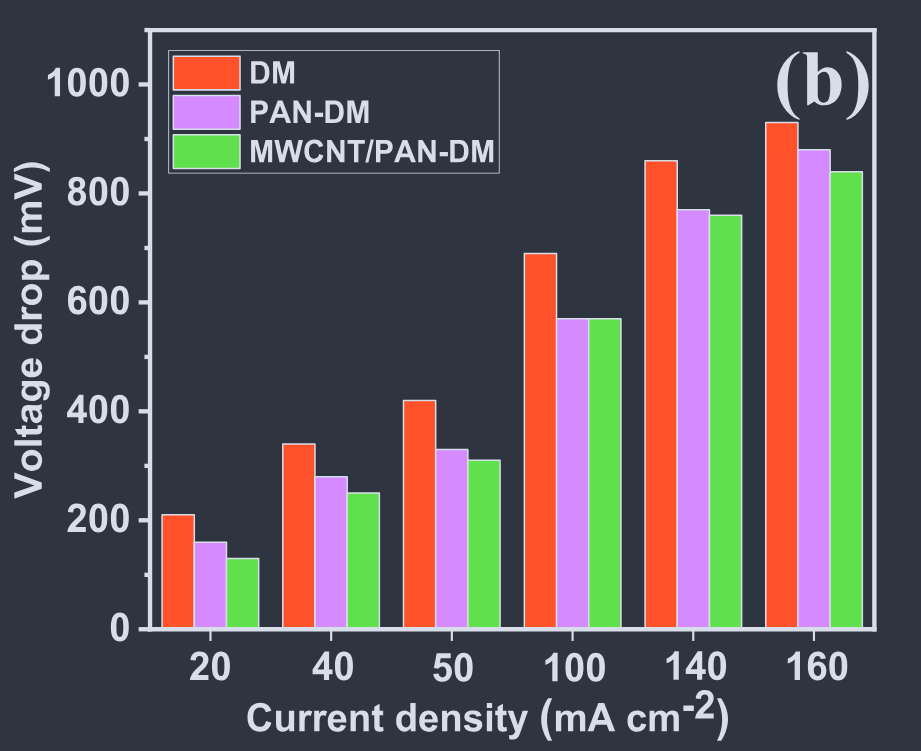
In membrane terms, this usually implies:
- lower internal resistance, especially lower ionic resistance through the membrane
- less polarisation, meaning less wasted voltage during operation
- better ion transport, probably Zn²⁺/Br⁻/supporting electrolyte transport
- less bromine/polybromide crossover, which reduces self-discharge and mixed-potential losses
- better electrochemical reversibility during cycling