Home | Projects | Classes Préparatoires (CPGE) | CV
Interfacial Double layer (DL)
A double layer is a spontaneous ionic structure of two parallel layers of charge on the surface of an immersed object.
- Stern layer : condensed counter-ions, stationary, adsorbed on the particle via chemical interactions
- Slipping plane (diffuse layer) : more mobile co-counter-ions attached via the Coulomb force, electrically screening the first layer, still under the influence of thermal motion
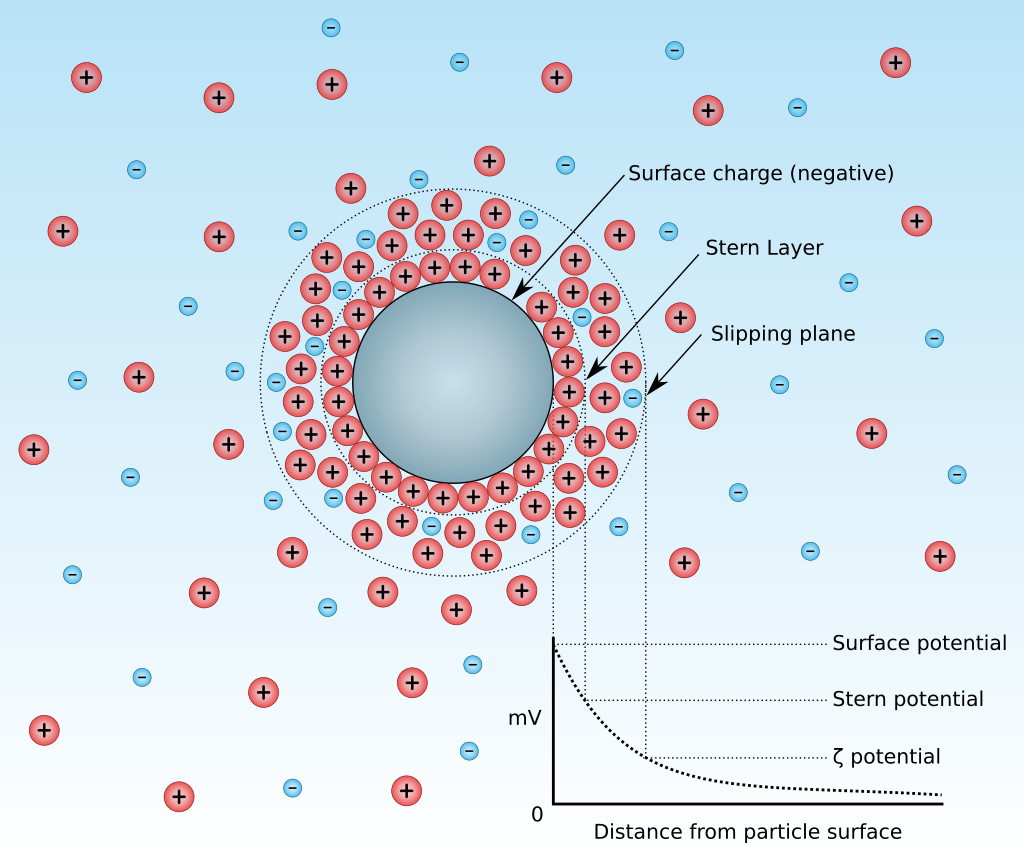
These structures are particularly relevant substances with high surface to volume ratios, such as colloidal solutions. Milk for example exists only because fat droplets are covered with a DL that prevents their coagulation into butter.
-
Key point: a high zeta potential
strong repulsion high stability with respect to aggregation at the bottom of the solution (and not suspension) -
Zeta potential : electric potential in the slipping plane, also called electrokinetic potential and often denoted as
-potential, it is used to estimate DL charge, usually in the order of tens of mV
Point of zero charge (pzc)
The pzc is the pH of net zero electrical charge of the particle surface, equivalent to
From the view of the adsorbent, if the pH of the solution is below the pzc value, the surface charge of the adsorbent would become positive so that the anions can be adsorbed. Conversely, if the pH is above the pzc value, the surface charge would be negative so that the cations can be adsorbed.
Experimentally, curves are obtained of acid/base amount = f(pH), and pH=f(
Sources: